︎
Panel: "
Marxisms from Nowhere: Recent Debates in Value Theory
“
![]()
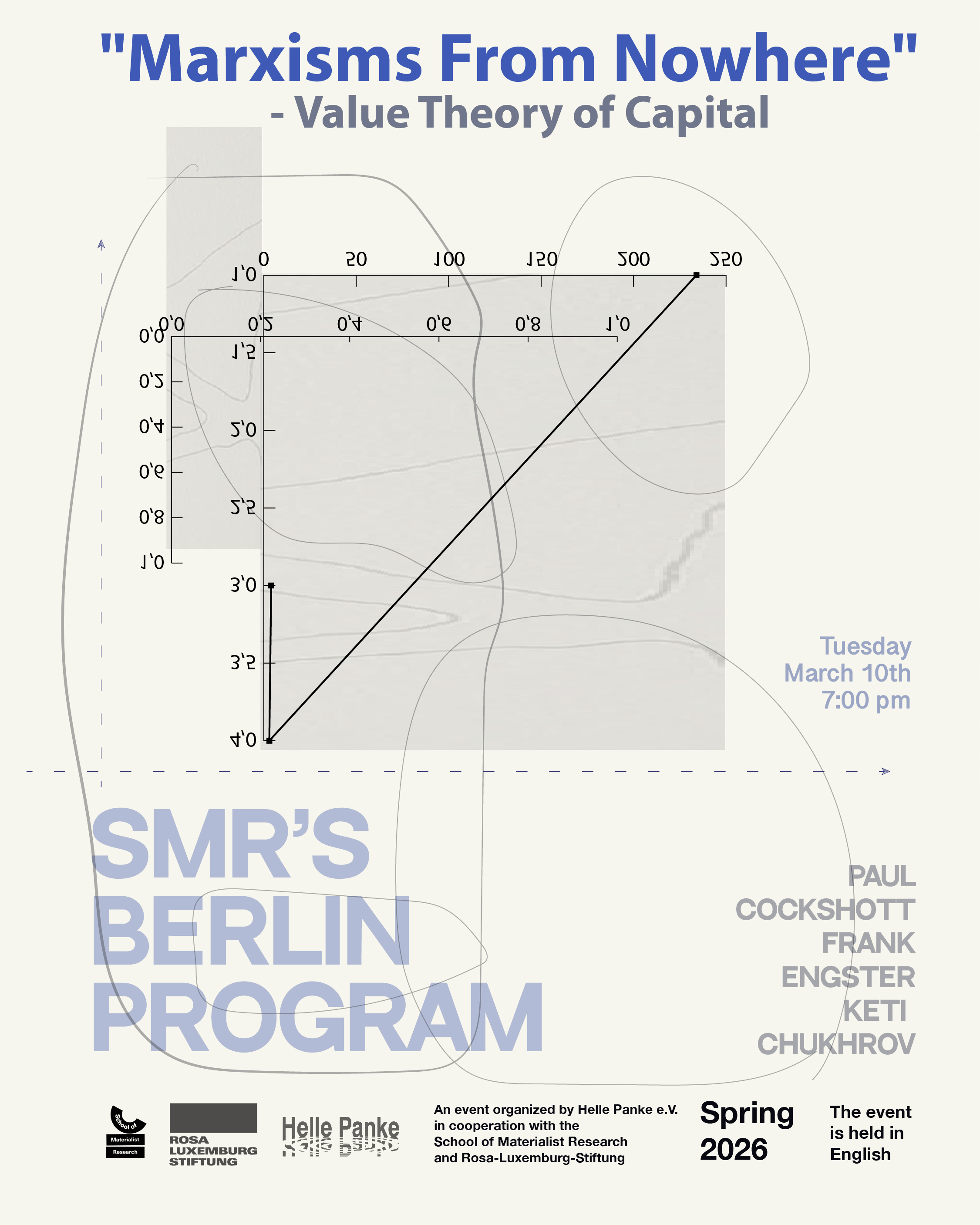
Tuesday, March 10, 2026, 7:00 p.m., Rosa Luxemburg Foundation, Eva Mamlok Library, Straße der Pariser Kommune 8A, 10243 Berlin
The panel looks into the most recent debates on Marxian value theory centering on the question of time while reassessing the concept of labour in an era of increased automation. The three speakers will revisit the more classical theories that informed Marx’s views on value and engage with the more recent contributions to the question at hand. The panel will thus tackle the situation of Marx and value from three angels:
- Paul Cockshott will talk about the view of Marxist materialism and value outlined in the book 'Defending Materialism'. This emphasises the debt that Marxian value theory owes to the development of mechanics which underlaid capitalist industry. Marx's explicit intention of revealing 'laws of motion' indicates the path. Paul Cockshott will focus on the role of conservation laws, energy, work and power as the underlying substructure of Marx's Capital, a structure that is made explicit by multiple asides in the book. The importance of this is that it re-emphasises what was long claimed, the scientific character of historical materialism and the way in which the same principles apply to the study of both inanimate and social matter.
- Frank Engster will discuss the connection of money and value in line with the socalled New Marx-Reading and its logica-categorial reading of Capital, but addressing its blind spots: the connection between measurement, quantification and time as well as money’s financial forms.
- Keti Chukhrov will discuss under the title Use Value Economy: Social Welfare or Philosophic Utopia?" that Marx, since he never experienced life in communism, could hardly imagine how exactly use value might actually have functioned. And yet he attempted to define the necessity of use value for the society of common good. By means of political-economic analysis he unraveled the most important aspects in the enigma of how surplus value is created. For Marx use value provides the potentiality of both social good and economic abundance. Usually when looking at the reasons of socialism’s failure, we search for its reasons in the capitalist distortions of socialism rather than in the logic of use value economy itself. My interest in this connection is to inquire what results the societies of former socialism demonstrate regarding applying the use value economy, and whether it is a viable condition within Marx’s constellation itself, in which advanced productive forces affect relations of production and lead to overall social emancipation. We shall try to explore whether the problem with use value is rooted in Marx’s initial positioning of it, or whether it arises in its distorted application much later in former socialist states. Hence the question: is use value a sustainable economic condition or merely a philosophical utopia? With this goal at hand, I resort to Evald Ilyenkov’s analysis of Marx’s study of surplus value, undertaken in his Dialectics of the Abstract and the Concrete in Marx’s Capital (1960).
Speakers: Paul Cockshott, Frank Engster, Keti Chukhrov, Moderator: Katarina Kolozova
Paul Cockshott trained in Economics and Computer Science. He worked in hardware design in the computer industry and as an academic researcher at Scottish Universities. His computing research has included data compression, parallel hardware, 3 D video capture, compilers etc. His economic research covers value theory, socialist economics and the methodological and philosophical foundations of historical materialism.
Frank Engster wrote his PhD thesis on the subject of time, money and measure. His areas of interest lie in the different - (post-)operaist, (post-)structuralist, formanalytic, (queer-)feminist etc. - readings of Marx’ critique of the political economy and especially in money as a technique and its connection with measurement, quantification, time and (natural) science. Some publications are available on academia.edu
Keti Chukhrov is a guest professor in Philosophy of Art at the State Academy of Fine Arts, Stuttgart. Her latest book Practicing the Good. Desire and Boredom in Soviet Socialism deals with the impact of socialist political economy on the epistemes of historical socialism. Her other full-length books include: To Be—To Perform. ‘Theatre’ in Philosophic Critique of Art (European Un-ty, 2011), and Pound &£ (Logos, 1999), and a volume of dramatic writing: Merely Humans (2010). Her research interests and publications deal with 1. Philosophy of performativity 2. Сomparative epistemologies and political economies of capitalist and non-capitalist societies 3. Art as the Institute of global Contemporaneity.
No registration necessary!