︎ EXTENDED DEADLINE for ICP FAll 2025 applications
Call for Applications
Informal Intensive Study Courses:
Integrated Credit Program, Fall Semester of 2025
![]()
Please, note that due to announcements of late applications we are officially extending the deadline until August 28th 2025
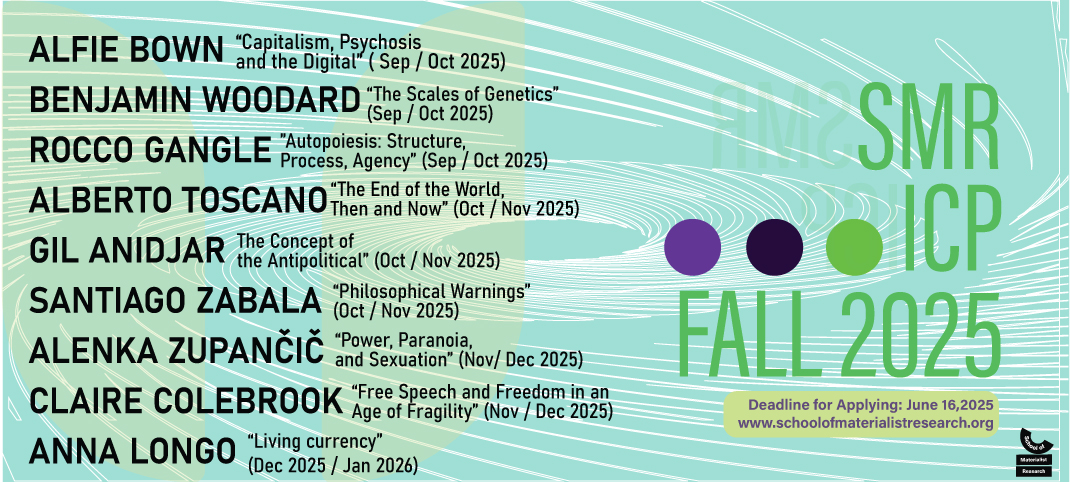
This Fall, the Integrated Credit Program (ICP) or Intensive Study Program (ISP), will offer unique insight in the ongoing research and theoretical-political preoccupations of our Invited Faculty, which even though rather different in nature are connected with the common thread of radical re-considerations of the notion of the political. Gil Anidjar offers an in depth introduction in the concept of the anti-political and the politically excluded endowed with a revolutionary potential that probably escapes the notions of the political, at least in its canonical, academic sense. Just as Anidjar finds some unexpected political potential in the religious (and mothers),, so does Santiago Zabala, and he does so by way of revisiting “God, science, gender, and evil” as discussed by Nietzsche, Heidegger, Simone De Boivoir. Zabala also engages in discussing the political concerns at hand: AI, anti-gender movements and banalization of war. Under the overarching theme of “politics, paranoia and sexuation,’ Alenka Zupančič dedicates a significant part of her course – understood as a shared process of inquiry – to the role of AI in this evolving landscape and its impact on our psychic and political life. Instead of revisiting the ossified concepts from the realm of political science and philosophy, such as “liberalism” or “illiberalism,” Claire Colebrook will offer a seminar on freedom (but also on the question of “freedom of speech”) from a Deleuzian perspective. Alberto Toscano, in a course titled “The End of the World, Then and Now,” will explore, together with the seminar’s participants, the questions of millenarian anticolonial movements and phenomenological psychiatry, Marxist anthropology and avant-garde literature and also address the issues of global heating and planetary “polycrisis.” Rocco Gangle offers a course on “Autopoiesis: Structure, Process, Agency” which does not engage in any politically urgent matter or anything ostensibly political, but rather invites us to examine the essential features of autopoiesis from the standpoint of the formal and ontological entanglements of structure and process. It also considers the problem of agency in this setting, which may invite some political discussion in the zoom classroom. Benjamin Woodard tackles the question of how popular conceptions of DNA have unfortunately collided with the resuscitation of the alt-right and its widespread disinformation campaigns about correlations between race, IQ, and sex. Alfie Bown invites us to investigate the links between capitalism, psychosis and the digital. Anna Longo proposes a deep dive in Klossowsk's reflection begins with a critique of Marxism which then allows him to initiate an alternative vision of capitalism in which it is the notion of affect and not that of work which becomes central. More details in the course abstracts below:
Alfie Bown
Title of Course: Capitalism, Psychosis and the Digital ( September / October 2025)
Description of Course: This course explores a number of areas in which digital life intersects with desire, including dating apps, video games, conspiracy theory hubs, meme communities, blogging, podcasting and AI. It argues that in analysing the digital subject, we can see a pattern emerging - visible both on the left and the right, among the progressives and the reactionaries - that can be understood as psychotic, in the psychoanalytic sense of the word. The word Psychosis plays various roles socially, medically and analytically, but in its formal psychoanalytic function as the description of a psychic structure, it can help us to understand the effect of contemporary capitalism on its subjects, without falling into oppositional or identatarian thinking. The course hopes to begin the work of learning to live in, or even oppose, psychotic capitalism.
Benjamin Woodard
Title of Course: The Scales of Genetics: The politics of contemporary genetics (September / October 2025)
Description of Course: From socio-biology, to forensic DNA profiling, to genetic genealogies. the behavioral, criminal, and other statistical extrapolations of genetics often hides its weak probabilities and contingencies under a veil of unassailable scientific ‘fact.’ To this end this project will examine numerous high profile cases and events (such as the OJ Simpson murder trial, the apprehension of the Golden State Killer, to anti-black mass shootings using genomic studies as motivation) to articulate the ‘common sense’ perception of genes as keys to social dynamics. In addition, this project will look at how the popular conceptions of DNA have unfortunately collided with the resuscitation of the alt-right and its widespread disinformation campaigns about correlations between race, IQ, and sex.
Rocco Gangle
Title of Course: Autopoiesis: Structure, Process, Agency (September / October 2025)
Description of Course: Autopoietic systems are systems with a repertoire of behaviors including the maintenance and reproduction of their own structure. Such systems include biological organisms, ecosystems, and human societies, but may also be instantiated in various formal and computational environments such as cellular automata. This seminar examines the essential features of autopoiesis from the standpoint of the formal and ontological entanglements of structure and process. It also considers the problem of agency in this setting. Elementary notions of category theory will be introduced as a framework for modeling and understanding these phenomena. No prior mathematical knowledge is needed.
Alberto Toscano
Title of Course: The End of the World, Then and Now
(October / November 2025)
Description of Course: This course will explore the contemporary insights that can be drawn from the Italian anthropologist Ernesto De Martino’s unfinished magnum opus The End of the World: Cultural Apocalypse and Transcendence. Ranging across millenarian anticolonial movements and phenomenological psychiatry, Marxist anthropology and avant-garde literature, De Martino’s capacious study of cultural apocalypses and “crises of presence” deserves revisiting (and critique) of the catastrophic horizons opened up by global heating and planetary “polycrisis”. We will put De Martino’s work in dialogue with the history of philosophical engagements with the apocalyptic as well as with a political conjuncture of climate ‘overshoot’ and recurrent genocidal violence.
Gil Anidjar
Title of Course: The Concept of the Antipolitical (October / November 2025)
Description of Course: Famous for his Black Marxism, Cedric Robinson had written an earlier book that has failed to garner the attention it deserves. Entitled The Terms of Order: Political Science and the Myth of Leadership, the book advances the argument that the field of political science — but the claim might be extended to political philosophy at large — is organized around a limited concern, an obsession really, around two concepts, namely, order and leadership. To think outside of these terms, to think, for instance, of “followership” or of “anarchy,” is to extricate oneself from the political and to begin exploring what Robinson calls “the antipolitical.” Key to Robinson’s argument, and accompanied by an incisive critique of Max Weber, is a rethinking of charisma, which, along with followership and anarchy, opens a range of critical issues we might call theologico-political, as well as antipolitical, but have been in any case ignored or marginalized by the Western political tradition. Among those issues, I myself have tried to argue, are the enemy and mothers. What I propose in this course is to reflect on Robinson’s argument on the antipolitical and to revisit my own. I want to do so by way of four “figures,” namely, mothers, the enemy, as well as God and civil war. Each class will be devoted to an exploration of these terms.
Santiago Zabala
Title of Course: Philosophical Warnings: Nietzsche, Arendt, Heidegger, and De Beauvoir. (October / November 2025)
Description of Course: This course aims to think of philosophy as a warning, and its goal is to outline Nietzsche, Arendt, Heidegger, and De Beauvoi’s warnings about the meaning of God, science, gender, and evil. We will interpret their ideas as philosophical warnings and show that their theses were calls to alter the future. The prophetic nature of these authors’ thoughts, as in that of the prophets of scripture, consists primarily in showing the meaning of the past and the present in relation to what will come. As we will see, these prophecies and warnings were meant to distance us from a future founded on knowledge, rationality, and progress. Exploring these thinkers; warnings will reveal a glimpse of the future (as “avenir”) of fundamentalism, unhindered AI, anti-gender crusades, and the banalization of war. This future demands our involvement because this is an existential affair; our salvation is always at stake in any philosophical warning.
Alenka Zupančič
Tittle of Course: Power, Paranoia, and Sexuation (November/ December 2025)
Description of Course: This seminar will explore some of the tectonic shifts that define and destabilize our social being—shifts that have already generated various “monsters,” understood here as symptoms that demand serious theoretical attention. Drawing on several key psychoanalytic concepts, we will aim not simply to “(psycho-)analyze” these monstrous indicators, but to map a topology of the places and contradictions in which they appear as displaced signs. We will also examine how these “structural” or “systemic” causes nonetheless rely on singular subjective idiosyncrasies that produce specific fantasies—fantasies which, in turn, frame our social reality and mobilize (or fail to mobilize) our passions. A significant part of our inquiry will be devoted to the role of AI in this evolving landscape and its impact on our psychic and political life.
Claire Colebrook
Title of Course: Free Speech and Freedom in an Age of Fragility
(November / December 2025)
Description of Course: On the one hand humans have announced their robust power in their capacity to transform the Earth as a Living System, and in their capacity to witness end times. On the other hand, there is a perhaps unprecedented expression of micro-fragilities — both a sense that ‘we’ are no longer able to speak freely and that ‘we’ are living in an age of weaponized speech. There are two warring senses of the fragile: a fragile planet and a fragile humanity. This is accompanied by incommensurable senses of freedom, a freedom of life versus a liberal freedom exemplified most in free speech. This course will approach the question of freedom, life and the earth through the works of Deleuze and Guattari.
1. Free Speech
2. Who is the earth?
3. Philosophy, Fate and Freedom
4. Freedom After the State
Anna Longo
Title of Course: Living currency : Klossowski and affective economy. (December 2025 / January 2026)
Description of Course: Pierre Klossowski’s Living currency is a complex and surprising essay that inspired Lyotard’s libidinal economy as well as Deleuze and Guattari’s desiring production. Klossowski’s reflection begins with a critique of Marxism which then allows him to initiate an alternative vision of capitalism in which it is the notion of affect and not that of work which becomes central. He puts forward the idea that economics – just like science, religion, philosophy, etc. – is only one of the ideologies, a contingent manifestation among others of the human passions. The adoption of point of view of affects in economic analysis allows him to clearly see the ambivalent status of money: at the same time a means to suppress desire through the satisfaction of needs, and what stimulates desire. The appearance of capitalism and together of big industry, Klossowski explains, led to a previously unknown situation in which inert money became the form best corresponding to the needs of emotional life. This enigmatic essay looks particularly relevant today as, by following Negri’s considerations on the central role of affects in the digital economy, theoreticians have been starting to explore the economic exploitation of the emotional life. In this course, we will read and interpret Klossowski’s text to open up a reflection of the latest evolutions of capitalism.
Further Information About the ICP:
Deadline for Applying:
August 28th 2025
Enrollment takes place in two stages:
- assessment of the quality of application by a faculty selection committee (not letter then August 31th 2025)
- enrollment fee 1st payment, to be completed 1 month after the notification of acceptance
Upon the completion of these two steps you are formally enrolled which will be confirmed by an official letter sent to your provided email address
Requirements:
Graduate level preparation for courses. Applicants do not necessarily need to have the formal level of education that is equivalent to second and third cycle university study programs, it suffices if they can self-assess they are capable of following the courses. Graduate level is second and third cycle as per the European Higher Education Area (Bologna Signatory Countries in Europe that issue ECTS credits, which include all of our European HEI partners at SMR) and as in North America. Integrated Credit Program is an intensive program of informal education co-organized by ISSHS (EHEA/ECTS institution) and ASU-CPT, in the frameworks of SMR, and our Estonian partner charged with organizational responsibilities. The selection of participants (students) is carried out by the academic institutions running the program.
The motivation statement embedded in the application form and the short bio should suffice to assess ability to follow the course. When you are applying for a given semester there is an application form in which you can fill out all relevant information. The link to the form is at the bottom of this page.
Credits and Certificates: About the ECTS certificates
Credits, depending on the number of courses and individual work put in, can vary from 1 ECTS to 4 ECTS credits. The certificates are issued by one of the European Higher Education Area member institutions of SMR, participating in the Erasmus+ program as full members holders of a valid Erasmus Charter of European Quality in Higher Education (ECHE). It is co-signed by our co-director who represents one of the founding institutions, Arizona State University – Centre for Philosophical Technologies. Note: ISSHS, just as the other founding SMR institutions from Europe—CIL- Design Academy Eindhoven and ATTP-Technical University of Vienna—is a holder of an Erasmus Charter of Excellence in European Higher Education Institutions 2021-2027, ISSHS has been accorded 97 out of maximum 100 points of the independent Erasmus ranking agency, which describes it as one the "best places to study in Europe." Arizona State University is a top US institution in the area of research innovation across a vast array of fields: in 2024 ASU is ranked nr. 1 in the US for global impact, innovativeness, and multidisciplinary research. ASU ranks alongside MIT, University of California-Berkeley, Georgia Tech and Purdue University and ahead of Carnegie Mellon University, Princeton among the top 5 universities in the US in a number of other categories https://www.asu.edu/about/rankings/ranked-number-one.
Participation fees:
SMR is a self-sustaining initiative with modest infrastructural support from its founding institutions. In order to maintain its independence from the founding institutions themselves and from major donor and grant programs it sustains itself through funds collected through participation fees. Our aim is to constantly reduce prices, increase the number of participants, diversify forms of participation and, through different forms of affiliation, expand and reinvent its concept of ownership. In the meantime, we suggest you apply for scholarships at your home institutions while we offer our forms of financial support described below under the rubric “scholarships.” In the meantime, this Fall's price list of participation fees is as follows:
One course: 110 euro (NB: A single course, provided individual creative work and study of minimum 28 work hours, is invested in it can bring maximum 1 ECTS credit)
Discount for combined multiple courses:
A package of 2 courses: 170 euro
A package of 3 courses: 220 euro
A package of 4 courses: 260 euro
A package of 5 courses : 290 euro
A package of 6 courses: 310 euro
A package of 7 courses: 340 euro
A package of 8 courses: 390 euro
A package of 9 courses: 410 euro
Hop-in and hop-out package: 300-euro fee which allows you to join and leave a course at your will and replace it with another, but you do not qualify for an ECTS certificate, but a certificate of participation without credits.
Scholarship:
A separate application form is available for the students (as always, they can be literally students enrolled in a higher education institution but also post-docs, teachers or independent scholars and everyone curious and self-taught) who will request a partial or full scholarship (waiver). The selection will be based both on quality (the scholarly potential of the applicant) and the criterion of the applicant’s stated socio-economic fragility. You can find the form here
Payment:
Payment instructions will be sent to all successful applicants at the same time they receive their acceptance letters. If anyone has difficulties to make the first payment which is necessary to officialize the enrollment, please contact us directly, and we will do our best to make sure we work it out together. If you wish to pay on installment plans, please be sure to check the relevant box in the application form.
How to Apply:
Interested applicants can find the full application form, as well as at the very bottom of this page. All application forms must be filled out in full and sent in by the above stated set deadline in order to be considered valid. If you have any inquiries please send them to all the following email addresses:
Isidora Hennig and Jacob Leveton at schoolofmaterialistresearch@gmail.com
About SMR:
The School of Materialist Research is an international platform, founded by the Center for Philosophical Technologies at Arizona State University, the Institute of Social Sciences and Humanities, Skopje, the Department for Architecture Theory and Philosophy of Technics at TU Vienna, which, in cooperation with the Critical Inquiry Lab at the Design Academy Eindhoven, functions as a global online school combining education, research, and mentorship to advance academic study at the intersection of the social sciences and humanities (SSH) and the STEM sciences.
ICP/ISP Schedule Fall 2025:
The general time frame of each course is already set, but we are not in a position to announce the final dates yet. We would like you to think of the program as an informal school, a study program, instead of a series of events. The times are normally 18.00 to 19.30 CET or 12.00 to 13.30 EST, but because of time zone differences there might be minor adjustments of 30 minutes to one hour, in most of the cases.
Application form