︎
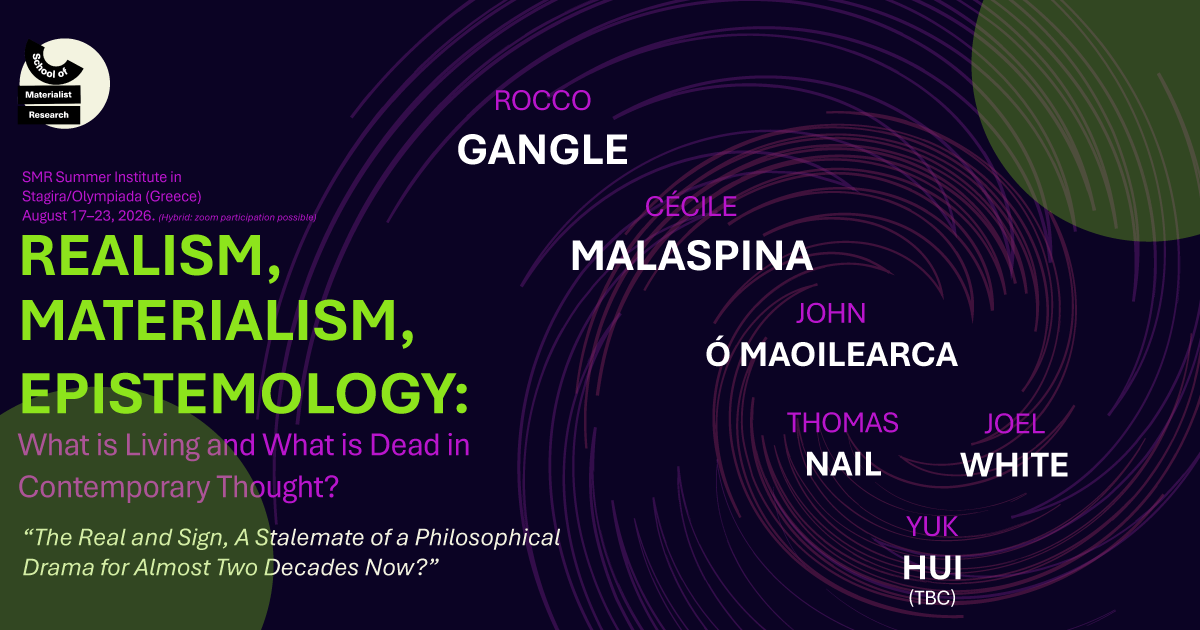
SMR Summer School: “
Realism, Materialism, Epistemology: What is Living and What is Dead in Contemporary Thought?”
SMR Summer Institute in Stagira/Olympiada (Greece), August 17–23, 2026*
![]()
"Realism, Materialism, Epistemology: What is Living and What is Dead in Contemporary Thought?," is the title of a summer school, part of the SMR Summer Institute in Stagira/Olympiada (Greece), scheduled for August 17–23, 2026*. It will explore the 21st century provocations and challenges to the dominance of the poststructuralist epistem across the humanities, social sciences, political philosophy, and beyond. This event invites us to delve into the motivations or epistemic necessities inspiring movements like speculative realism (SR), non-philosophy or non-standard philosophy, new materialisms (Utrecht school, Barad, vibrant matter), Lacanian realism, kinetic materialism, xenofeminism and/or accelerationism, and most recently cosmotechnics as an epistemological shift. We do not intend to study any of these strands of thought as subject matter of the school but state them as a non-exhaustive list of what we consider to be symptoms of the crisis of the poststructuralist (maybe even postmodern?) epistemic hegemony. Many have since moved away from either SR, non-philosophy or non-standard philosophy or from feminist materialisms, but their links with sciences have become even stronger. Even without embracing an ontology of materialism, the link with the sciences via the interrogations of material reality seems to ensure some connection with the interrogations of the real or in terms of the real, or even physicality as opposed to the spectral selfufficency of the universe of language, signification, Sign. Present currents engage with hard sciences and technology and some with Marxism or both with STEM and Marxism, challenging the hegemony of poststructuralism’s authority without fully displacing it. What unites these shifts, and how do we name this evolving paradigm which emerges perhaps even before the so-called "speculative turn" and the rest that followed? Confirmed speakers: Rocco Gangle, John Ó Maoilearca, Thomas Nail, Cecile Malaspina, Joel White, Yuk Hui (pending reconfirmation) and
Jason Andrey Bonilla (guest lecturer).
Masterclass descriptions
John Ó Maoilearca:
As Good As Things Get: Structure, Scale, and Reciprocity in the Attribution of Life and Lifelessness
If we were to follow the logic of the phrase ‘there are no things, only relations between things’, then the status of ‘thing’ here (as object, as substance) may well have its reality thrown into question. Yet, no less problematised is the reality of relation too, qua any structure or sign ‘between things’. In this talk, I would like to adopt an alternative posture in between that of any realism or anti-realism towards both things (object-ivism) and structures (relationalism) through a kind of ‘quasi-realism’ of life. Here, it is the life (and lifelessness) of things attributed as temporalised part-whole structures that is paramount. Such life/non-life attribution will be posited as a scalar phenomenon, a dyad that is projected, and introjected (reciprocated), through imaginary ‘as-if’ solutions (hence, the name ‘quasi-‘ realism). This quasi-realism will not be offered as a consolation, however, but as a plausible alternative to much either/or thinking (relation over object vs. object over relation), one that is as good as (living) things get in the realm of metaphysics.
Cécile Malaspina:
System restore & update on techno-capitalist individualism
I’d feel like I was doing something wrong or not well enough, or that I wasn’t being “real” enough — and it broke my brain. Olivia Muenter (49.3k followers on Instagram) .
Does the real hide in depths that withdraw from phenomenal experience? Is it the sting of an absolute contingency, or what resists symbolization absolutely? Is it what persists after extinction? This talk will offer a late rejoinder to the conversation about speculative realism. Its protagonists have moved on, but they have left behind some loose ends. One of these threads we will pick up here: the individual, but perhaps not as you know it.
Reading Scotus on the principle of individuation, his 13th century contemporary Mauritius realised that the subtle doctor leads us – lentu passu, slowly and steadily – into metaphysical chaos. It is on this chaos that this lecture will dwell. We will attempt a system restore of our conceptions of individual reality, back to the moment just before Scotus’ metaphysical chaos was aborted by way of Ockham’s razor. With contemporary updates from Gilbert Simondon, we will throw a conceptual spanner in the works of techno-capitalist individualism: calling the bluff on empiricism’s statistical categorisation of individuals, and puncturing the superbia of its heir, the digital tokenisation of reality.
Rocco Gangle:
Semiotic Immanence: Peirce, Deleuze, Category Theory
This seminar explores connections between Peircean semiotics and Deleuze’s metaphysics of immanence using formal tools drawn from category theory. The introduction of these elementary mathematical techniques will be used to elaborate and synthesize immanent metaphysics and semiotics in ways that make these philosophical approaches accessible to and relevant for current developments in systems theory, complexity and information science. Peirce’s semiotics supports an interpretation of compositional relations as the basis for a metaphysics of structure, individuation, and information. Like the concept of difference for Deleuze, signs for Peirce are not just one special type of entity but are potentially the global configuring principle of process, relation, and existence in general. By embedding semiotics within the framework of category theory, Peirce’s powerful theory of signs can be readily applied to computational processes, complex systems and a great variety of phenomena susceptible to scientific mathematical treatment, integrating these with Deleuze’s metaphysical framework of immanent difference. For the seminar, no mathematical expertise beyond an ordinary high school level of understanding is required or expected.
Joel White:
Empirical Realism Reloaded
Is this it? Have we—philosophy—finally exited the ignorance of correlational bliss, relinquished the transcendental, and come face to face with the noumenal Real? Is there now no way back from these New Realisms, these Object-Oriented Ontologies, these Vibrant Materialisms? Are we, as they say, “red-pilled”— swimming at last in the speculative seas, drowning in the univocity of Being and Thought? Or, instead, as if swimming forward through Riemannian curved space, have we not just resurfaced somewhere all too familiar, somewhere all too correlational? The commendable side-step into mathematical formalization and the positive sciences performed by these New Realisms has simply led us back to the same question that critical philosophy began with: if mathematical formalization and the positive sciences provide us with judgments concerning the
Real, how do we account for these judgments? Is there a difference between what can be imagined (mathematical formalization) and what can be experienced (the positive sciences)? Indeed, at the very heart of the positive sciences lies the correlation, not between a subject and an object, but between the intuitable form of mathematics and the empirically measurable field of observation. Reality, as any good empirical realist will tell you, emerges only where these two meet: where the formal conditions what can be experienced, and experience confirms what can be formalized. If we are to take mathematical formulation and the positive sciences seriously as two of the strongest means of overcoming both naïve idealisms and realisms, then it is time to reload empirical realism; to once and for all recognize that reality is neither a hidden noumenon nor an object of mere thought; it is the product of the ongoing interplay between what in actuality can be intuited and what, in concreto, can be experienced.
Thomas Nail:
Pink Noise: A Process Theory of Consciousness
What might a non-naive realist and materialist theory of consciousness look like beyond the familiar substance-based accounts found in the philosophies of mind? Why are there so few process-based philosophies of consciousness? This presentation, draws on the last decade of research in the neuroscience of noise and new materialism, to propose a new process theory of consciousness, which diverges sharply from anything found in the philosophy of mind.
For almost a century, scientists have told us that “background brain noise” is random and unimportant. They have painstakingly filtered and averaged it out of their data. However, in just the last two decades, increasing scientific evidence has now confirmed that this “noise” is neither random nor unimportant. It is involved in all aspects of brain functioning. It’s integral. And this integral pattern is one shared nearly universally in the natural world, allowing us to see our brains and bodies as continuations of a much larger cosmic processes. Ultimately, I propose, this finding also fundamentally transforms what we usually mean when we talk about “realism” “materialism,” and “epistemology.”
Jason Andrey Bonilla
Metaskepticism and the External World: Hume on Factual Speculation
The inflection between the question concerning the causes that lead us to believe in the existence of bodies and the question of whether bodies exist or not truly inaugurates contemporary philosophy, insofar as it separates what is “given” from the reflection upon it. We find its first formulation in Hume, specifically in one of the most original parts of the Treatise, where he points out the central problem of radical skepticism: the skeptic is forced to accept the existence of objects, even though he cannot support that belief with any philosophical argument (T 1.4.1). Hume’s theory of the external world, then, problematizes the causes that lead us to believe in the existence of objects.
Such an inflection operates in Kant with the distinction between transcendental knowledge / phenomenal world; in logic with the distinction between meta-language / object language; and in Meillassoux with the distinction between metaphysics (dogmatic) / speculation (factual). In fact, the fourth chapter of After Finitude (“Hume’s Problem”) is quite well known, where a solution is presented through the Cantorian transfinite. In this proof —Meillassoux’s bluff, since he offers a demonstration he does not yet have— we find the most ambitious attempt to relinquish the transcendental in twenty-first-century philosophy so far. However, following Rodrigo Nunes, I maintain that speculation and correlation are not mutually exclusive: metaskepticism is a default stance we fall back on when we recognize that our speculative claims are possible rather than necessary—thinkable but not knowable in any empirically meaningful sense. Metaskecpticism is not skepticism. In this sense, the speculative (ontological) turn and the zetetic (epistemological) turn coincide in a third-order level concerning the undecidability of second-order statements, that is, in a meta-discussion about the norms of inquiry already present in Hume's critique of Pyrrhonism.
Practicalities: application process, ECTS certificates, fees, and hospitality at the campus including a week to eight days of accommodation
Application process
We invite you to apply as a participant to the summer school which allows you to simply follow the program but also to submit a proposal to present in the afternoon panels. Apply on this link. Based on your application, and particularly the motivation section of the application form, we will select not more than 25 prospective participants for in person participation and not more than 10 for online participation. The online component is fully integrated in the program which takes place fully in the zoom room as on-site. All discussion and interjection in exchanges must take place via zoom as well, a task for which SMR is fully prepared in 2025.
You can access the application form directly by clicking on this link
The deadline for submitting you application is January 30th, 2026
Program completion and certificates
We issue ECTS certificates for the participants of the Summer School that are students, and for the teachers and postdocs certificates of participation to include in their professional portfolio.
Scholē (in the original Greek sense: leisure and study as part of it), or simply time for pleasure and relaxation, is as important as the program itself: It is a key part of the overall experience, and we will make sure to allow for sufficient beach time, as the Campus is placed only 40 feet away from the beautiful city beach of Olympiada, and only 1000 meters from the site of ancient Stagira and the beautiful rocky beach next to it called Amos. The break between lunch and late afternoon sessions will allow you to do just that: enjoy a holiday in Greece with peers with whom you can exchange all sorts of ideas inspired by the morning talk, discussions and the informal program we (but also you) will put together such as movie nights with wine, and similar.
Accommodation at the Campus
In the dormitory area we offer fully furnished and newly built bedrooms, toilets, and showers, and shared spacious balconies facing Mount Athos where you can have your breakfast if you choose so. Along with the accommodation you receive access to the kitchen/coffee station, cookers and laundry area in case you want to quickly prepare your meals or wash your cloths. Also, we will all sometimes cook for you or cook together. Breakfast is served every morning.
The kitchen/laundry area is linked with a corridor with the classroom area, a building attached to the dormitory, and will be accessible between 09.00 AM and 07.00 PM. To see the capacities of the building, check out this website https://www.smrgreece.com/ Breakfast will be served every morning with a rich variety of choices, covering a spectrum dietary preference including vegetarian and vegan. (Additionally, we will try to provide some gluten free options as well, but we cannot guarantee the quantity as our supply options are relatively limited.)
We have included additional pieces of furniture, decoration, balcony furniture and other details and we trust you will enjoy your stay. Keep in mind that we cannot accommodate more than 13 participants at the campus. Some of you will have to arrange your own accommodation in Olympiada which, if shared, is quite affordable. So, if you wish to be housed by us, try to submit your application as soon as possible.
Hospitality is handled by SMR – Greece, our partner company, and the fee it charges is 470 euro per week (you can stay an extra day or two, if necessary, you won’t be charged extra) including VAT (24% of the total).
Program fee
This fee is charged to help raise funds to reward our speakers, onsite team that would be cleaning and cooking for you, the coordination and organization assistants, and to be able to treat with you with both great food and program too! The program fee is 550 euro, and it will be charged by one of the academic institutions constituting SMR as a platform or one of the partner institutions depending on program responsibilities. Some of you can apply for partial waivers and the criteria as always are a balance between your academic merit and your socio-economic situation. SMR affiliates are automatically granted 40% discount.
Note: Most of our participants are funded by their universities and thus require our invitation to apply for funds. So, if this is your case, apply sooner rather than later in order to arrange the letter of support or invitation that you will require for your university’s financial support. Some of you will need a Schengen visa and therefore should also submit sooner rather than later (these participants will have to be housed at the SMR Campus).
Transportation from and to the airport
There is public transportation leaving straight from the airport which is one hour away from the Olympiada. However, if you want to arrive fast and comfortably, we advise you to take the Hellenic Transportation shuttle and share it with other participants (a ride costs 100 to 130 euro). We can help organize you in time-slots depending on your arrival hours so you can share a shuttle for approximately 30 euro per person or less, and also book the pickup for you.
Online participation
The online component is fully integrated in the program which takes place fully in the zoom room as on-site. All discussion and interjection in exchanges must take place via zoom as well, a task for which SMR is fully prepared in 2026. Your experience will be seamless as close as possible to being at campus in person. You can also apply to present as part of the official program. Participation fee for the online component is 370 euro (VAT included).
*
The work program always begins on Mondays, so 17th in the morning and runs till Satarday evening (or August 22th); we include a day extra for an arrival (16th) and departure (sometimes two, if we can offer program, but not in this case) as we consider these extra days reserved for beach time and relaxation as part of the overall "program" in the wider sense of the word (including the unofficial part)